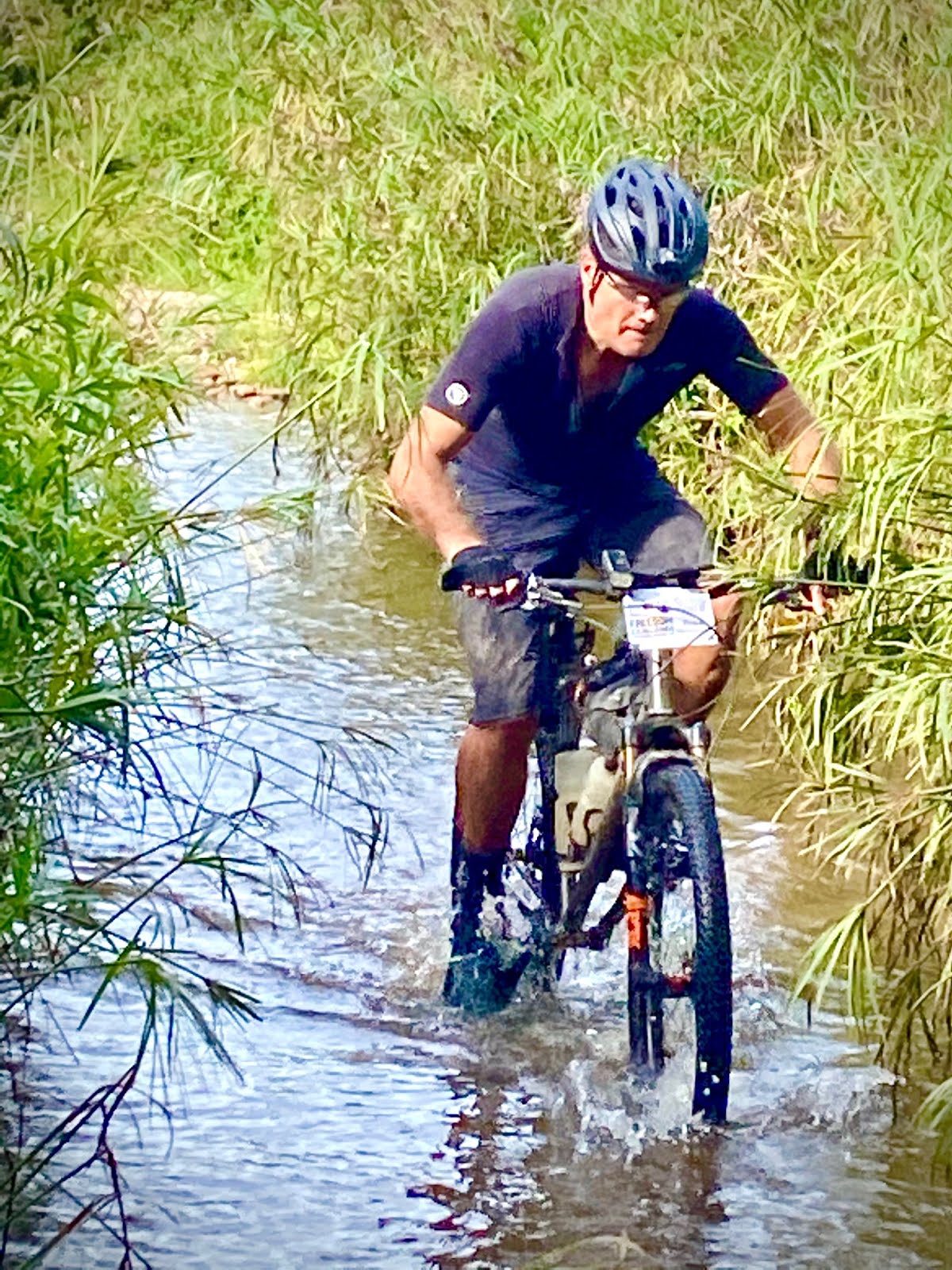
Sunday, 3 April 2022
The Accidental Single Speeder - Race to Cradock Part 2
I had yet to make peace with a rigid fork and was convinced that every rough section on the road was going to dislodge me from the bike. To be fair, even with a suspension fork I'm extremely cautious of unleashing my bike down a road that is anything but perfectly smooth. Often I'm the guy who gets to the top of a climb at the head of the bunch and then ends up trailing the group on the downslope.
I'm envious of my riding pals who let rip every time the gradient points down. However I'm not envious of their scars or the plates and pins that hold their bodies together when unfettered joy gives way to grunts and groans. I'll acknowledge that I let the fear of falling off exaggerate the actual risk.
I traced the route out in my mind. The big climb soon after leaving Rhodes is broken into 3 steep sections that I could expect to walk. The new section after passing the Bokspruit turnoff up to the radio masts would be a certain walk. After that it’d be a fast section down to the steel bridges that cross the Bell and Kraai rivers. A left turn toward Elliot would have me on a road if never travelled. Once rejoining the normal route there were at least 2 steep sections I'd have to walk before the Bottlenek turnoff. Then there was Bottlenek itself… there was going to be ample opportunity to walk.
Had I chosen the right gear ratio? I didn't know. I had a 32 chainring and the sprocket that was in the spares box was a 16. My choice of ratio was as simple as that. It's what I had and it would have to do.
How was that going to translate into travel time? I figured I could add an hour between each support station. I was hoping that I could stay in touch with the other riders who were in 2 distinct camps - those looking to chill day by day and a few who were looking to go as hard as they could. Ingrid Avidon and Peter Roux, the latter on a fast looking gravel bike, would be my progress markers. If I could stay in touch with them then I'd have a chance of finishing within the 58 hour time the FCSF supports had deemed a suitable target time for me. I thought that was a fair target and hoped that I could go under that. I'd gone under 48 hours on 2 previous occasions. By adding the additional 1 hour per support station to those 48 hours I was hoping to cover the distance in 54 hours. It was a big ask particularly as the added time on the trail would lead to added sleep deprivation which would have to be worked in somewhere along the way.
"It's 5am so you better get on your way," came Chris's voice out of the dark. I pressed the pedals and started heading down a familiar road on my unfamiliar rig.
Friday, 1 April 2022
The Accidental Single Speeder - Race to Cradock Part 1
"Chris I'm done."
"What do you mean?"
"I mean I'm pulling out of the race, I've had enough. This sucks."
"But Mike, you're almost in Hofmeyr."
" I don't care. Besides, at my rate of travel it going to take me many hours to get there. And the flippin' mosquitos are eating me alive."
"Mosquitos in the dry Karoo?"
"Not funny!"
I had reached the nadir of my riding exploits. The recent feeling that I was well past my use by date stared me in the face. That's what happens when a challenging situation collides head on with a negative attitude. I'd let the conditions and a bike I was uncomfortable with get to me. After only 36 hours into the Race to Cradock (RTC) I was ready to give up. There's so much you can't control but your attitude is one thing you can. I had loosened my grip on that. But let's rewind to where this adventure started and how I came to be on the phone to Chris.
Roger No Trophy Nicholson had entered RTC with the express purpose of doing it on a single speed. In the process, assuming he finished, he could lay claim to the single speed record for the race as there are no other single speed attempts on record. He spent many hours trying to convince me that I should go one gear as well. I don't own a single speed bike and had never ridden one. For me it seemed a silly thing to do—civilisation has led to mountain bikes with gears. My regular bike sports a very handy 9/52 rear cassette which I couple with a 32 tooth chainring. It enables me to go fast on the flats and climb almost everything the mountains can throw at me without tearing the tendons off my knees. The knees I refer to are attached to my spindly legs which have never been referred to as gnarly looking pedal pistons.
Apart from my well geared and lightweight Alibaba special I have a second bike which had been on loan to a work colleague while he was repairing his own bike. He had found a single speed conversion kit in a box of bike parts a friend had left me when they emigrated. In no time at all my spare bike was fitted out as a single speed. He had even dug out a rigid fork I had bought years back. When I got the fork I had tried it out on a single ride before it was removed and tossed into a box labelled "Things I Hate".
In passing I mentioned to Roger that I had a one gear bike at the office and the nagging mounted for me to do RTC on it.
Two weeks before RTC my regular bike had a few spoke nipples pop through the rim. 48 000km's, countless river crossings and many litres of corrosive tyre sealant later the aluminium nipples had reached end of life. The bike was liberated of its wheels which were dropped at the local bike shop to get respoked.
3rd March 2022 will go on record as the day I first mounted a single speed bike. I could have changed my other bike back into a proper bike but decided to see what it was like. I didn't like. The vibration through the unforgiving rigid fork was awful and hills I'd never thought of before made themselves known. I looked forward to getting my proper bike back. Many trips to and from the bike shop had me returning home empty handed. It seems the spoke sizes were outside the regular range and had to be specially ordered. That being the case my only option in the interim was the torture machine.
A day later I went on another ride with Roger and Carlo to familiarise myself with the beast ahead of a long final training ride with Roger the following day. The ride with Roger and Carlo was torturous. They possess good tech skills and race down tracks I wouldn't send my pet goat down. I tried to keep up but the pair spent many minutes waiting for me. I didn't trust my front wheel without a shock to compensate for my lack of skills. I gingerly picked my way down the rock strewn and water eroded paths the other two revelled in.
The following day we had scheduled a long ride over flat terrain and Roger insisted that I ride my single speed otherwise we'd have a speed differential problem that wouldn't be fun - not that I had another option bike wise. As the sun peaked over the horizon we started out on our bikes and hadn't gone more that 1 km when Roger lost control of his bike and hit the deck hard. The deck being a combination of concrete and tar. He was properly broken. A two minute car trip for him and a short pedal for me had us back where we started. While I was in a state of shock over the extent of his injuries Roger was doing a self assessment trying to figure out if he would be okay for RTC which started in 12 days. My 3rd ride on a single speed was severely curtailed.
Over the next few days, while waiting for my proper bike wheel set to come back from the bike shop I kept riding the single speed. On one ride with Mrs Robinson I told him that there was no way I was going to do RTC on the SS. A side note is necessary here. Gavin Robinson was an early adopter of personal pronouns. His being He, Him and Mrs. It's a long story but he is known in our circles as Mrs Robinson.
News from Roger didn't look promising with new complications arising until a scheduled surgical repair put paid to any chance of him doing RTC. I had already decided that I was going to go with my regular geared bike up to that point. Now that Roger was out of the race a small irritating voice in my head - which did sound a little like Roger - kept saying, "Go on, do this for your buddy." It's a sobering moment when your resolve against something dissolves and you pivot your decision against your best judgement. There had already been people offering up support for a SS ride by way of donations to the Freedom Challenge Scholarship Fund (FCSF) if I'd do it. This was initiated by Roger weeks before and others had joined the chorus. I have a heart for the FCSF so this was a cheap shot that worked. Once I'd announced my intention to go SS in place of Roger the support from the FC family via the very active and supportive Whatsapp group caught fire. Because of Roger's unfortunate accident I had become an Accidental single speeder. The hook was set. It was time to get me and my unfamiliar bike to the start line in Rhodes.
Monday, 10 May 2021
In Pursuit of Perfection.
In this guest post Kevin Benkenstein reflects on his winning performance on the inaugural event of the Freedom Circuit
In Pursuit of Perfection - Kevin Benkenstein
Freedom Circuit was a race of progress for me, the first time that I felt everything click in the way that I wanted, allowing me to paint the picture of the race that I imagined in my head. Sitting here a week and a bit later it still seems unreal that it all came together, but I am oh so happy that it did. These were the keys to that performance for me.
You do you
The first and most important thing for me was to just be myself. I was about to ride an event about which I had very little knowledge, other than that it would be hard, and before which there was a lot of noise, good and bad, from the side benches about what my potential performance could be. None of that mattered in reality and so I chose to focus on myself, my strengths and my performance. I knew what I have done in the past, what I was doing in my training rides and also, maybe most importantly, I knew what I had no experience of and so stopped worrying about it. I did what I am good at well and made the rest up as I went along, albeit with maximum effort.
Ignorance is bliss
Ultra-racing can be so unnecessarily complicated and it truly does not need to be. Endless pre-event research, route analysis, proposed timing splits, terrain knowledge, and so on and so on. I won't lie it tires me out and has over-complicated too many rides for me in the past. I rode Freedom Circuit almost blind, other than Chris's most helpful cheat list of food and water stops, and I tried not to overwhelm myself with information before the event. This allowed me the chance to let go of the unknown and focus on my next goal, staying in the moment.
Stay in the moment
When racing an ultra I have often fallen into the trap of 'saving myself' for later, also known as not doing what needs to be done now because I am scared of the hard work later on. I have become adamant that this is a fallacy, as the ebbs and flows of energy in an Ultra (not to mention all of the external uncontrollable factors) mean you never know if you're going to feel good when later comes. I decided that I would meet every challenge with maximum energy, which in Freedom Circuit generally meant finding a way to ride every climb/grass field/goat track/something else seemingly unrideable. By focusing on the challenge in front of me, not the one miles away, I was able to do my best in (almost) every moment and collect those best moments together to put forward a best performance. Saving yourself for later, I think, results in later never really coming around.
Always move forward, never quit
The two greatest lines of instruction that I have ever received were: 'Always do what needs to be done to keep moving forwards'; and 'We never quit Benky'. Both of these came with long discussions around what those lines mean but their essence is simple and seemed to be said out loud every time things got hard. There's always one thing that you can do to move further forward, at your best speed, and there's always another minute of effort left in your body when you feel like quitting (even just quitting a small task like riding down a hill past Glen Edward while falling asleep on the bike) and that knowledge kept me moving when things got extra hard.
Another pearl of wisdom that I remembered along the way: "Just ride 300km a day. It's so simple, I don't know why everyone doesn't do it." I remember saying that to myself a few times pre-race.
One step at a time
Not just a Pop song that was stuck in my head for many a kilometre, this is also something that I truly believe to be a key component of every long ride I do now. Ultra-distances tend to feel overwhelming, how does one actually contemplate riding 700km non-stop? Breaking these distances into smaller, more achievable, segments makes the journey that much easier. Focusing on a 40km stretch between water stops, or a portage section, or a series of climbs and ticking each of those off is far simpler than riding 700km, and once you've done enough of them you have ridden 700km, and so my Garmin never showed me how far we'd ridden as a whole, just how far since the last obstacle was completed. This keeps me in the moment, stops me thinking about how bloody far we have ridden or must still ride, and gives me an achievable goal to always move forwards towards. At 60km to go I added back my 'total distance' screen and focused on that goal, but for the 635km that preceded that I worried about the small tasks along the way that needed to be completed to earn the right to chase that final goal.
Have fun!
Racing an ultra can be distinctly not fun: The fatigue; The sleep monsters; The never stopping; The lack of human company; The hallucinating. To be honest I am not always sure why we sign up for those things, but I think it is because of the fun things.
I made a conscious effort to enjoy the parts that I love about riding and to take the time to appreciate them: I paused as I rode over the top of climbs to take in the view; I did hill intervals, challenging myself to ride a certain speed/power even when that speed/power was embarrassingly low; I sat on the grass and ate a bar and closed my eyes so that I could really listen to what was around me; I stopped to watch Eagles soar, pretending that I had half a clue what Eagle it was; I raced descents; I learned new riding skills; I smiled when I saw something that made me happy; I greeted everyone and spoke to them too, when the chance allowed. I also went on a group ride at 3am on the second morning with a bunch of imaginary friends, but that's another story. Ultra-racing really doesn't seem fun but when you make it so the experience is that much sweeter, and that was the biggest of the keys to my personal performance.
The Pursuit continues, but I am a big step closer to the rider I hope to become.
Thursday, 6 May 2021
Freedom Circuit - Snatching Defeat from the Jaws of Victory

As I left the Lodge at Ntsikeni I scanned the distant horizon to see if I could see Tim's light. The southern horizon like every other direction was pitch black thanks to the overcast sky that obliterated the moon. Good, when Tim got to the Lodge he'd see that I left well ahead of his arrival. That should give me a huge mental advantage. I figured it would take me no more than 7 or 8 hours to get to the finish. If I could hang on to the 2 to 3 hour lead I'd maintained over the last few days it would be a simple matter to finish ahead of Tim and claim second place behind Kevin Benkenstein who had already stormed to a well deserved win.
There'd just been a huge thunderstorm that left the ground sodden and soft underfoot. I'd gone no more than 100 metres from the lodge and I was tossed off my bike. I had no idea what I'd ridden over or in to cause my front wheel to wash out. Rain streaked glasses made for poor visibility.
I have a riding Achilles heel - I can't ride in the rain. It's not a mental problem. I wear prescription glasses and without them I can't see well enough to ride at any pace more than a jog. Particularly at night. On a smooth open road I can take a chance but if it's even slightly rough with a chance of me putting my front wheel where I shouldn't it's a big problem. On technical tracks or even single track I'm reduced to a crawl.
I remounted my bike and tentatively made my way from the lodge stopping often to assess difficult looking bits of track.
By the time I exited the reserve it had started to rain again. The ground turned to sludge. I crossed a patch of rock and mud so slippery that I had to use my bike to support myself as I inched my way across. I tried to convince myself that it was a passing shower and that if I could get to lower ground it would ease. That was wishful thinking. Soon it was hosing down. I was getting soaked and visibility was now only good enough for me to walk. That meant I couldn't generate sufficient heat to counter the chilling effect of the rain. I needed to get out of the rain. I knew there were some huts nearby but it was 11:45pm and that's not the time to be knocking on someone's door. I couldn't do it. I did the next best thing. I hauled out my emergency bivy bag. I set it under some wattle trees next to the path and slipped inside. I dragged my backpack inside after me and did the best I could to keep the opening closed sufficiently to keep the rain out.
An emergency bivy bag is essentially a foil bag that looks like a giant chip packet. By the time I'd wiggled in carefully so that I didn't puncture it by pushing my cycling shoes through it I was soaking wet. Adding my backpack made for little wiggle room.
I lay there with the rain noisily hammering down on the foil bag mere inches from my ear. I pulled the opening over my head doing the best I could to make sure the top flap overlapped the bottom flap so that it wasn't acting as a gutter which would fill the bag with water.
The bivy was in contact with me on the inside and icy rain on the outside. There's no insulation. Eventually I started shivering. Shivering is the body's way of generating warmth. That being the case I embraced the shivering and got my whole body to quiver. After 20 to 30 seconds I would stop and felt a lot warmer. This would be repeated every few minutes.
I decided I should let the race office know I was okay. It took me a solid 5 minutes to locate the backpack pouch I store my phone in and retrieve my phone. It'd help to be a contortionist in the confined space of the chip packet. It would have been easier if I had arms like the stubby front legs of a Tyrannosaurus Rex. It turned out that I had no signal so used the torch on the phone to locate the OK button on the tracking device. That would hopefully let the race office know I was fine. But I wasn't fine. I was wet, cold and my legs were cramping. I was miserable.
I checked my phone. Had only 5 minutes elapsed since I last looked? This was going to be a long night. I was too cold and uncomfortable to sleep. Besides, if I didn't keep control of the opening flaps the rain and wind would make sure I was awake.
I decided that I had to do something to distract myself from my misery. What better way than to update the race blog on my previous race. Easier said than done. My fingers and phone screen were wet so I couldn't type. I needed to dry both. I managed to get a tissue pack out my backpack but it was a soggy mess. Then I remembered that I had a roll of toilet paper in a ziplock bag. 5 minutes later I dried the screen and my fingers sufficiently to type. Every now and then a drop of water from the condensation in my chip packet would fall on the screen requiring me to go through the whole palaver of drying both screen and fingers.
The rain eased for a few minutes before resuming with not only the previous vigour but this time accompanied by a howling wind that had me trying even harder to keep the rain out of my flimsy foil fortress.
I'd been typing away for an hour before I had a brainwave. I had no cell signal but I was in a foil bag. What would happen if I held the phone outside the bag. I tried it. Sure enough I got a 3G signal.
I typed up a message and pressing send extended my arm out the bivy; It's raining and windy. In my bivy in a wattle forest waiting to see if it stops. Ground is slippery as snot. Can't see without my glasses with the rain so can't ride like this .
I retracted my arm and checked my phone. It had worked. At least someone else knew I was miserable.
Time crawled, agonising minute by agonising minute. I had ample time to reflect on how I came to be laying on the ground in a crinkly chip packet getting lashed by rain and wind instead of being in a nice warm bed 9 kilometres back at Ntsikeni. We were racing. The "We" being Tim Calitz, who I'd never met, and myself. The race had already been won by Kevin Benkenstein - there was no one in the race who could match him. That left the race for second place the one to play for. I had passed Tim as he lay on the floor nursing an aching back at Flitwick 450 kilometres back. Since then I'd kept my eye on him. The gap between us has fluctuated between 1h40 and 3h30. Tim had spent more time at support stations so I imagine he'd got some sleep. As for me, by the time I'd left Ntsikeni I was almost 62 hours into the race and had only slept for 90 minutes in total. It was woefully inadequate. My plan was to get on the road well ahead of Tim and have a few power naps along the way.
(Post race I see that I left Ntsikeni 6 hours ahead of Tim. In hindsight I would have done better to sleep at Ntsikeni for a few hours. The clarity of hindsight.)
I had contemplated sleeping at Ntsikeni but the weather forecast was for the prospect of rain to get worse not better. I thought I may as well head out while there was a break in the rain. I'd done just that and now I was enwrapped in my foil wrapper.
At around 03:30 the sound of rain falling on the bivy lessened. I poked my head out and although misty there was only a light drizzle. I wormed out of my cocoon, added a dry base layer and headed off hoping desperately that once I had dropped off the mountain the rain would have stopped.
Over the next 90 minutes I had only covered 9km as the rain had resumed. Once again I needed to get out of the rain. Getting back in my bivy wasn't an option as the ground was sodden. I looked to see if there was a house close to the road that had an overhang where I could sit or stand out of the rain. I saw a house with an open gate and a small stoep. I guided my bike into the yard and stood under the overhang. It was still cold but at least the rain wasn't pelting me.
The stoep I was standing in was no more than 1 metre deep. Leading off it were 3 doors which I assumed were bedrooms. I couldn't just stand there unannounced. I was happy enough to wait out the rain on the stoep but wanted to do so with permission. It was 05:10 which while still early was better than midnight. I knocked on the door in front of me and got no response. I knocked again. A door to my right opened a crack. I asked the person inside if it was okay to wait on the stoep. I was told to knock on the door I had already tried. I knocked and still got no reply. At least I had made my presence known.
I sat down with my back against a pillar and draped the bivy over my shoulders. The man I had spoken to earlier emerged from his room and walked away leaving me squatting on the dry strip of concrete. 10 minutes later he returned. He went into his room and retrieved a thick woollen jacket which he handed to me. He then indicated that I should follow him.
I followed him across the yard and into a corrugated shelter in which a fire had been started. I gathered that it was where he prepared his food. He pushed a 20 litre plastic drum in my direction and I sat across the fire from him. The warmth of the fire combined with that of the jacket did wonders for how I felt. With steam rising from my clothing I watched as the man stoked the fire with wood.
I asked his name. Papelo. I sat mesmerised by the warmth giving fire. Papelo's shadow played on the corrugated iron behind him—a manic dance in contrast to the man who sat still and silent before me.
When the fire had settled into a good mix of flame and hot coals Papelo held out a bucket containing cobs of maize. I took one.
"Another?" asked Papelo. I declined thanking him for the one I already had. Not sure of how to proceed I mimicked Papelo as he stripped the green outer leaves, snapped of the end and removed the silk before placing it close to the glowing embers. We sat there silently, the only sounds the rain drumming on the tin roof and the crackle of the fire, occasionally rotating the maize as the fire worked its magic. Once the cobs were uniformly auburn we popped the warm kernels off and ate.
Papelo asked where I was from before offering that he was from Maseru in Lesotho. He works for a local man who deals in sheep and cattle for which he is paid a pitiful wage.
With the thrum of rain on tin and the mesmerising dance of flames the accumulated exhaustion caught up with me. I fell asleep. I woke suddenly falling toward the fire. I spread my arms and managed to arrest my fall before disaster played a hand. Papelo reached forward and steadied me. The concern writ large on his face.
We continued sitting there in silence. Two men, one from a world of privilege the other from a life of need. In that place our roles were reversed, albeit temporarily. I had need of warmth and shelter and Papelo met that need without hesitation or question from the little that he had. We sat around the fire as two men sharing the simple yet vital comfort of the fire as well as the presence of each other's company.
The rain slowed and then stopped. The clouds lifted revealing the light of dawn. It was time to go.
Returning to the road I could see fresh bike tracks. Tim had passed me. I pushed hard and judging from the way passing cars had obliterated his tyre tracks he was no more than 20 minutes ahead of me. Using this method I established that I had closed the gap to within 10 or 12 minutes when I could no longer stay awake. The lack of sleep had finally caught up with me. I had a 10 minute nap and remounted my bike moving ahead at a much slowed pace. The chase was over.
By the time I got outside Colford Lodge I needed to sleep again. I propped my bike against the stone wall and sat next to it.
I heard a voice, "Hello? Are you okay?"
I opened my eyes. A lady with child in arms stood 20 metres away. She looked worried. I assured her that I was okay and her relief was palpable.
I continued on until I got to the tar road crossing which left 23km to the finish. It was a simple ride to the finish but simple is not ideal when having to deal with sleep monsters. As expected they ravaged me. A few times I woke up having turned 90° and heading directly into the ditch. I was so discombobulated that a few times I had to check for my tyre tracks so I knew which way I was supposed to be heading.
I saw Benky who was driving on his way home. He stopped and we chatted for about 10 minutes. I didn't mind the distraction or the wasted time. A couple of riders doing the 400km race came up the road and I fell in with them. It kept me from falling asleep. Once they got 50 metres ahead and I started nodding off. I then made a point of sticking with them. Bizarrely, as we got to within 250 metres of the main gate of Bushman's Nek I nearly fell asleep twice. It was a struggle to the very last pedal stroke.
I completed the race in 76 hours 4 minutes a far cry from my pre-race prediction of 60 hours and 1 hour 43 minutes adrift of Tim Calitz.
Monday, 3 May 2021
Race to Willowmore 2021 - Part 12: Cambria to Willowmore
Llewellyn Lloyd-Reblex Photography
Once I had sorted out my bottles and had something to eat, I was ready to bank some sleep. It would be the first since I had started 35 hours before. I removed my shoes and soon after setting a count down alarm for 60 minutes I was sound asleep.
Waking at midday I heard Roger chatting to the buffalo herders in the adjacent room. He had recently arrived and didn't have time to nap. He said he was heading down to the gate as soon as he had something to eat and I should wake him if he was asleep when it was time to go. I asked how he was feeling. He said he was fine. One look at him suggested he was exaggerating. I was exhausted but at least I'd been able to snatch some zzzz's.
Roger left for the gate and I followed 5 minutes Iater. Arriving at the gate I saw Roger propping his bike against a fence. I asked Llewellyn, who was our anti-buffalo chaperone, how long Roger had been there. He had just arrived. That didn't bode well. I felt pathetic on my 20 minute pedal to the gate and still made up 5 minutes on Roger.
Paperwork complete and the sleeping giant awoken we got on our way. We would have Llewellyn in his Suzuki Jimmy for company over the next 50km to where we'd cross the final cattle grid that supposedly marks the extent of the marauding bovines.
The first climb out of Cambria is tough. As in 650 metres of ascent in 10km tough. It can be ridden, even on tired legs but Roger and I had been pushing hard all the way from Cradock. As we hit the first climb Roger got stuck in. He was trying hard but realised walking might be the better option when I overtook him while pushing my bike.
When you're tired and approaching the limit of your ability to stay awake there is a disconnect between your head and your legs. It's like trying to drive a car with a slipping clutch—the engine makes all the right noises but it doesn't result in meaningful wheel traction and forward speed.
Physical exhaustion and mental fatigue are different. You can be physically capable of pedalling but when sleep deprived it becomes a battle of will over need to sleep. Roger was on the brink.
I was no match for him on the descents but he was getting slower on the climbs. 4 hours into our vehicle accompanied traverse through the Reserve I could see that the battle was swaying in sleep's favour.
We finally crossed the cattle grid that signalled the end of the escorted section at 17:30. Another 10km would have us clear of the Reserve. I pushed ahead over the worst section of road I had encountered the entire trip and reached the gate well ahead of Roger. I asked Llewellyn where Roger was. He said he'd go back and see.
The road out of the reserve was it's normal corrugated self. I constantly switched sides looking for a decent line. It was after 18:00 and I still had 17 or 18km to get to Damsedrif and then on to Willowmore a further 82km. It seemed like I wasn't going to get in on time. Rounding a corner the road surface improved dramatically. I rolled along comfortably until just before Damsedrif where the smooth road gave way to corrugations. Not nice to ride on but still better than the last two times I'd been on this road.
I rolled into Damsedrif at 19:10 which was 20 minutes faster than I'd hoped for when leaving the reserve.
It's always great to see Runé and Hestelle van Rensburg. They've seen me at my worst and have nourished and succoured me at those times. Sitting around the kitchen table We ate and caught up with each other's news. A quick look at the tracking site showed that Roger had gone to ground about 10km short of the support station. There was no waiting for him. I needed to move on.
I turned to Hestelle and said, "Hestelle, now is the time that you lie to me by saying the road all the way to Willowmore is in great shape."
"It's as smooth as a highway," came the reply.
The section of road immediately after Damsedrif has broken many a spirit over the years including mine a couple of times. I've suffered over endless kilometres of edge to edge corrugations that suck you dry of any desire to keep pedalling.
"Actually Mike, it's a lot better than the last time you were here," she added.
As I sat finishing a cup of tea I started nodding off. Skrik waker I think it's called in Afrikaans - startle wake or something like that. It wasn't a good sign. I dread the ride out of the Baviaanskloof especially the first 50km. It's hard but pleasant enough riding but I've always done it when tired resulting in countless power naps and wasted time.
Hestelle suggested I have a sleep before pushing on but if I wanted to get in before 2AM I couldn't. I needed to get back out on the road. I asked Runé how long the ride to the finish would take. He said most people take 7 hours. It was 19:30. Another 7 hours would get me there at 02:30... that was 30 minutes later than my target.
There was the risk that I would fall asleep soon after getting back on the bike but I figured even if I fell off the bike 5km up the road I had 5km less to do once I woke up.
Hestelle handed me some toasted sandwiches which I stuffed in my shirt pocket and at 19:40 I was out the door.
I set myself an initial target of 5km. This elephant was going to be eaten one nibble at a time. To stave off the sleep monsters I rode hard. I figured the burn in my legs would keep me focussed. Soon 5km became 10km and then 15km. I was in a good rhythm and before long I had passed the Makkedaat Caves and was closing in on the Nuwekloof Pass. The pass is majestic. The snaking road is tightly enclosed on either side by vertical rock faces that at night resembled cathedral spires reaching skyward. I got off my bike halfway through and walked for a few minutes while eating the toasted sandwiches. The silence engulfed me. The thin strip of night sky above cropped by the soaring cliffs.
I continued on past the Uniondale intersection which meant I had 32km to finish. It wasn't yet 23:00 so unless something went horribly wrong I'd be in before my 02:00 goal. A few kilometres later I started to nod off. I stopped and had a 10 minute power nap before pressing on to Willowmore. It was 00:49 when I pulled up outside The Willows Hotel.
The usual well done's and congratulatory words were offered and accepted before we turned our attention to Roger. He was still in Damsedrif. Unless he was back on his bike in the next few minutes he wasn't going to finish before 06:00 to achieve his goal of finishing in under 48 hours.
I last checked on him when I got into bed. He had left it too late. He arrived in Willowmore at 08:45. In spite of all the hard work and suffering he had endured the sleep monsters had won that skirmish.
Saturday, 1 May 2021
Race to Willowmore 2021 - Part 11: Mordor
The ride along the Osseberg jeep track can be challenging and there have been a few mishaps with riders over the years. Those mishaps have resulted from the gnarly track being littered with holes and numerous washouts. I guess it depends on your perspective. Some people revel in the challenge of snaking over the mountains on this disused jeep track before plummeting down the mountain to the river. Others are not so enamoured and choose to walk the trickier sections. I'm neutral. I aim to be efficient and safe.
The track from the insistent but ineffective NO ENTRY sign and rusty boom was interesting to navigate in the predawn darkness. I could see where the once good jeep track was but it is now obscured with fynbos and often only a single track would be visible with occasional sections where with both sides were washed out.
One year I arrived here at a similar time of day in the company of Graham 'Tweet' Bird. I crossed the boom and started walking down the track as any sensible person would do when faced with a dangerous track at night. I hadn't gone more than 20 metres when Tweet came rolling by. It was a huh moment for me. Throwing caution to the wind I hopped on my bike and followed him down the track. I figured if there was a race ending hole on the track Tweet would drop in first and as such would alert me to the danger.
This time I had no such scout as Roger was lagging. I scanned ahead looking for holes and rocks as my bike rolled carefully down the track. I had time, this didn't have to be a do or die experience. While I wasn't going to walk, except where riding was impossible, I wasn't aiming for a personal best along the 10kms that ended at the river. A safe passage in reasonable time would suffice. I'd initially allocated an hour to get down in daylight but as I was running under lights for the first half it would take slightly longer which I didn't mind as I had the extra time.
I spotted the occasional car tyre track and sections where the fynbos had been flattened suggesting a vehicle had recently been along the track. It made the going easier but I had to wonder what a vehicle was doing on that track.
Halfway along the peaks I looked back and could see Roger's light against the eastern sky that was finally relinquishing its hold on the night.
By the time I got to the final drop off to the river I no longer needed my lights. Approaching the river I saw there was a vehicle and trailer camper parked in the centre of what used to be a camp site. It seemed they were still asleep. So a vehicle had been down the track. Mind boggling. How long did it take?
As I got to the bank of the river I saw Estelle making her way into the reeds. It was 06:30 – the perfect time to start the Mordor adventure proper.
I know most of the Freedom Trail route well enough that I don't need maps. Even so I always carry the maps as arrogance precedes failure. There is one place where maps are essential and that's Mordor. My custom maps, pieced together over the years, have details of distance between river crossings as well as the line to take when crossing the river. For example, when entering the first river crossing the line is to go right at 45°. Going straight over you'd be faced with a 2 or 3 metre cliff to scramble up. It's tough. I've done it. Once. Going right brings you to the start of the jeep track on the other side with no scrambling required. Still lots of bushwhacking needed to get through reeds and bushes as is the case for every crossing.
I knew there were 9 crossings and the first was behind me. The last 2 are a little tricky but didn't require advanced ninja skills. That left 6 to tackle. Today these crossings exist as ghosts of yesteryear and live on merely as a line on a map. Standing in the bank there is nothing to suggest there is a place to cross. At one point I stopped and tried to imagine what it was like for a bunch of 4X4 enthusiasts to bring their growling machines through this valley. It's a pity access to this valley is restricted to a few dozen mad cyclists, and the occasional group of horse riders. It's a raw beauty that should be more accessible.
The second river crossing is over 100 metres as the line across is roughly a 30° angle. For the first time through the valley I stopped and had a good look at the routing over the rivers. The river when not flowing strongly, which is most of the time, looks like a string of beads. The river is essentially a series of big ponds of water linked together with reed beds. The crossing points are over the shallower reed beds, some of which are directly across the river and others that are diagonally across. With that understanding I was able to picture the line across the river before engaging in battle with the reeds.
The section between river crossing 2 and 3 is head office to the dreaded katjies. Not kittens. These things are not warm, cute or cuddly they are bloodthirsty cactus. I believe their official name is jointed-cactus. They lie in wait on the ground where they get picked up your tyres and then tossed onto your leg. To remove them it's best to flick them off with a stick. If you use your fingers they will happily transfer to your finger. I crossed that section without a single katjie incident. I was really pleased with this and nearly made it out of the valley without one of these on my legs. Alas, just before the last river crossing a single katjie latched onto my ankle. An elusive katjie-clean-passage was not mine to claim.

Most crossings correlated with the maps with one or two being more creative than the line on the map suggested. In all cases the crossings were achieved without any drama. I was across the last river just before 09:30. With the risk of time wasting drama behind me I could have a slow 10km ride to the support station at Kudu Kaya.
It was a slow ride. Without the need to focus on navigation or moving speed I became aware of how tired I was, both physically and mentally. Fortunately I'd be able to get some horizontal time before commencing battle at 1pm.
It was 10:22 when I signed in at Kudu Kaya. Priorities were; sort out bike, tea, food and then bed.
Monday, 26 April 2021
Race to Willowmore 2021 - Part 10: Bucklands to the Osseberg
Llewellyn Lloyd - Reblex Photography
11:26pm. Back on the bike. We'd been on the go for almost 18 hours. As you'd expect we were starting to fatigue. The aftermath of the mad dash from to Bucklands was still evident in my legs. I wasn't too concerned as the ride out the back of Bucklands through the neighbouring farm of Tretyre wouldn't be too taxing. Or so I thought.
We had 12 hours to cover the 96km to Kudu Kaya. That would give us time to eat and refresh before ambling off to the gate for a 1pm start. Sounds simple enough. 96km's at the average speed we had managed getting to Bucklands - 16.2km/h - that's less than 6 hours which means we could catch the 6am shuttle from the gate. If only.
I broke the route down into bite size chunks. We were tired so I added wiggle room.
Passing Hadley (42km) 03:30AM
Crossing the river in the Grootrivierpoort (52km) 04:30AM
Start of Osseberg (65km) jeep track 06:30AM
First river crossing (75km) 07:30AM
9th and last river crossing (87km) 10:30AM
Kudu Kuya (96km) 11.30AM
If we could keep to that schedule we'd be fine. For me it was important to get to the start of the Osseberg jeep track around first light. If we got there earlier it would take slightly longer to get across the mountains and down to the first river crossing because the track is perforated with holes dug by every critter from aardvarks to dung beetles. These bike size holes are easier to spot in daylight. But earlier was always going to be better than later.
There was more soft sand than usual in the crossings over the Grootrivier on the back exit of Bucklands which had me pushing my bike. Once away from the river the going improved. Soon we were through the boundary gate between Bucklands and Tretyre. I've always found the section through Tretyre a lot harsher than Bucklands. The veld thinner and it's rockier. I'm always amazed that sheep can find sufficient grazing.
We had progressed no more than a few hundred metres when we found ourselves trying to pedal through a sandpit. Roger was a lot more determined than I was. I saw him mashing his pedals and forcing his bike through the sand. I yielded quickly and walked. For the next few kilometres we encountered sandpit after sandpit. I don't recall ever having to ride through sand on this section. I concluded that runoff from the recent heavy rains, in an area that has been in the grip of a drought for the best part of a decade, had deposited the sand onto the jeep track.
I was walking more than I was riding. Roger was riding more than he was walking but he wasn't getting away from me. At one point I saw him attack a deep section of sand which ended with him toppling off his bike head first into a bush. Clearly the sand had won that skirmish. I chuckled loudly before regaining my composure enough to ask if he was okay. He was fine.
We eventually made it to the final farm gate out of Tretyre that emptied onto a good district road. It had taken us 90 minutes to cover 20 flat but sandy kilometres. The next 20 kilometres to Hadley would be on a good district road but from here on out there were a lot of hills to be climbed with what seemed a lack of corresponding descents.
Cresting a climb I looked back and Roger was nowhere to be seen. Apparently sleep monsters were in the early stages of laying siege.
I arrived at the gate to Hadley at 02:30AM which put me an hour ahead of schedule. I could see Roger's light in the distance. In this part of the world you can see lights forever. He could have been 1km behind me or 10km. I couldn't tell. At least he was still moving.
It was only 10km to the river crossing at the bottom of the Grootrivierpoort dropping 400m over the last 4km. It should have been a quick pedal but the terrain is such that it took 45 minutes. The exhilaration of the final 4km descent was tempered by the knowledge that I would have to regain the altitude I'd lost in the 4km's after I'd crossed the river.
I plodded through the river and started the steep climb up the other side. I guess a reasonable cyclist could ride most of the climb out from the river on fresh legs but I wouldn't know because every time I've gone up that climb it's been on tattered legs. This time it was no different. I turned and watched Roger's bike light tracing a line down the mountain toward the river below me. He wasn't far behind.
The track flattened out sufficiently for me to get back on the pedals. The start of Osseberg jeep track lay 10 tiring kilometres ahead.
At the top of the final climb before dropping to the start of the Osseberg jeep track I stopped and scanned the valley below looking for signs of life. If Roger was out there he was either running dark or he was lagging.
I rolled to the start of the jeep track and stepped around the NO ENTRY sign. It was 5:15AM.
Saturday, 24 April 2021
Race to Willowmore 2021 - Part 9: Bucklands
Llewellyn Lloyd- Reblex Photography
Arriving in Bucklands ahead of schedule took pressure off and gave us wiggle room. However, Bucklands wasn't the place to cash in those credits. I'd rather get within spitting distance of the gate before throttling back. Things could still go wrong and I didn't want to rue wasted time in Bucklands if I was a few minutes late for the gate.
Getting through support stations quickly is key to moving down the trail efficiently. Henry's assertion that he and Pieter are able to ride quicker is not without merit but by getting to Bucklands 50 minutes faster than them we'd demonstrated that we were able to move faster. Moving time is the sum of riding time and time spent at support stations. Last year Pieter and Henry lingered in Pearston and Toekomst. To be fair their strategy was to stop and sleep at Bucklands. They had a plan and executed that plan to perfection. They were never aiming to make the 1pm gate.
Getting through support stations quickly is an art. Unmanned support stations are easier as you can focus on getting yourself ready. Manned support stations present an opportunity to interact with the hosts. This interaction, unless you're being completely selfish, takes time and adds a few minutes to your turn around. But it is possible to get yourself ready and converse at the same time. If it takes a bit longer to chat then spend the extra time. Support station hosts play a critical role in the functioning of the race and without them there is no race. Besides, you're in their home and it behoves one to be respectful just as we'd expect that courtesy if we had people moving through our homes.
Over the years I have refined my support station routine:
Park my bike and take empty water bottles and trash inside.
Sign in
Dispose of trash
Find my resupply box
Refill my bottles and return them to my bike
Take out the snacks, spares and things you need from your resupply box and pack them away on your bike or in your backpack.
Get Food tea/coffee
Pack padkos if available
Bathroom break if required
Sign out - take photo of sheet for post race analysis.
Get back on the bike.
There are a few other considerations. Find an exclusive space where you can place your helmet, gloves, glasses, backpack and anything else you remove. Don't mix your stuff up with someone else or put it in a cluttered space. If you start with an exclusive clear area when you leave it's easy to ensure you have everything when the area Is clear.
If you need to charge a light, phone or powerbank leave something critical next to the device being charged. It could be your helmet or glasses or even gloves - something you know is missing when you're ready to leave. Too many devices have been left tethered to a plug point when it's owner has long since left the building.
My routine has evolved over many years and regularly adapted to address inefficiencies and mistakes. Figure out what works for you. You don't have to get in and out in 10 or 15 minutes but you do need to leave with all your stuff, full bottles and adequate nutrition.