Saturday, 14 December 2019

Munga 2019 - Part 2 - Off We Go

The start line bunting is removed. We are seconds away from days of anguish. The young man to my right looks eager. He also looks far too young to be doing a race like this. It turns out he rides for a road team. This isn't a road race. He might think he knows what it's like to suffer but he doesn't. Not yet. In a few hours he'll be properly blooded as he joins the ranks of those who have gone to the brink and beyond.

It's midday. The race is on. Last year it was about 28°C at the start. This year it's already in the mid 30's. At least we don't have a howling headwind.

Less than 2 km into the race and I see a water bottle fly free of young guy's bike. He hasn't noticed. I bring it to his attention and after a brief pause he pulls over to retrieve his bottle. The corrugations at this point are bad but not nearly as bad as the ones a few kilometres ahead. If it isn't tied down the corrugations are going to claim it. I lost 2 bottles in quick succession three years back. Since then my bottles are firmly secured with elasticated cord.

In no time at all young guy is back in our group, water bottle stashed in a back pocket. As I struggle to find a smooth line through the corrugations young guy is bouncing around next to me holding his phone aloft taking pictures fore and aft. He's having a blast—for now.

The first few kilometres are relatively civil as the field starts shaking out to suit individual ambitions. The race snakes are jostling at the front. I'm tagging along behind them watching for the break. I'm not joining in when that happens. Not that it wouldn't be a blast but I don't have the power or speed. It's fun to watch though. No one makes an early break and the big names roll along together. Ramses, his GPS device still not working, misses a turn and him and Piet Laubscher who are at the front head off in the wrong direction. Instead of cashing in on this early mistake Benky and Marco call out alerting them of their error. They turn and are soon shoulder to shoulder with their peers.

I look around and familiar faces are close at hand. Rafeeq Safodien is just ahead, Janine Stewart is right behind me as is Mickael Da Matta Sant'anna. I met Rafeeq in 2016 when we rode together from WP6 to Loxton. We fell into easy conversation as we rolled along. It was good to chat and we kept each other from falling asleep. Mickael hails from France I met him and his friend Alain Broglia (also back this year) when they flew over to do their first Munga a few years back. In Mickael's words, "We are here because we read your blog... many times!" Janine, one of my homies, is looking strong.

I watch the lead group, a few hundred metres ahead, round a corner and head into the farms. A rough count places me 15th. We were only 15 km into the race but at least I can now keep a mental note of where I am in the field. Rather insignificant but it's all part of the mental game that plays a part, albeit rather small.

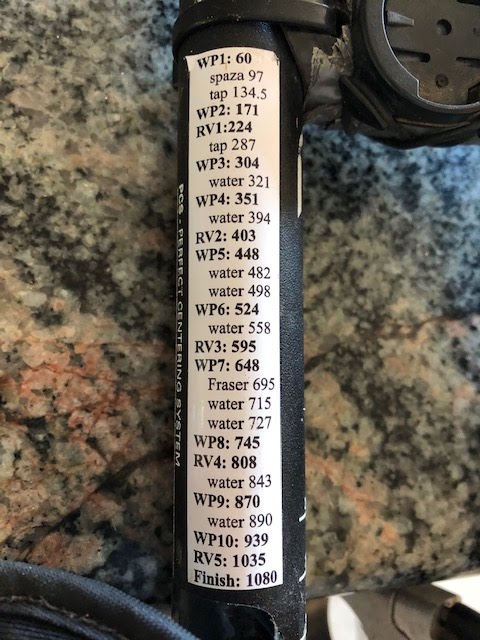
I put in a spurt and reel in a few riders and settle into 13th spot. Only 1050km to go! In practice it's best not to think about how far you still have to ride. The focus, especially being as hot as it is, is to ride from water supply to water supply. These are mostly at official Race Villages or water points which are typically spaced 60 to 80km apart. There are other spots where water is available such as a farm shop 97km into the race. There are also farm taps and farm reservoirs where you can fill up. Last year I slipped past WP1 at 60km and stopped for the first time at the shop a further 37km up the road. This year that's not an option.

As I'm barrelling along I get a rude reminder that my idea of barrelling along is the next guys idea of trundling along when Dana Schutte and Jean Biermans fly past me. I don't recognise them at first and give a big kick to get onto a wheel. It takes a while but the penny eventually drops and I know I'm in the presence of riding royalty. When I drop off a bit Dana swivels an arm around and points to his back wheel beckoning me to close the gap and take advantage of a draft. Drafting is permitted up to Race Village 1 at Vanderkloof 224km into the race. Drafting as and when you can makes sense but once you're into farm tracks the risk of being swallowed by an unseen aardvark hole is a real possibility.

The elastic breaks and I'm back in 15th spot. That is until I spot Piet walking through sand pushing his abomination. Those who know me know that my opinion of gravel bikes is that they are abominations. To be fair it's an uninformed opinion based on nothing of substance. To support my view it's best to ignore the fact that Benky went on to win the race on an "abomination". Anyway, skinny tyres and sand pits 800 metres long are not good bedfellows. I slithered through the sand as did everyone else around me except for skinny wheel Piet. Trudging through thick sand in the heat wearing carbon soled cycling shoes should be added as an Olympic Decathlon event. It's far more challenging than shot put and will quickly separate the men from the boys.
That's the last time I saw powerhouse Piet.

The route winds through some farms where we skirt around holes and do the best we can to avoid sandpits. We empty out onto a district road and I can see riders ahead and behind. All the while you are going through farms it's okay. It's a bit slow but you stay engaged. Once you get onto a long straight road with a headwind and a noticeable incline all you can see is the schlep that lies ahead and it's demoralising. All the while the mercury is ticking up.

My focus now is on my Garmin. I'm begging the numbers to tick over. It's only another 10km to water point 1 but that seems so far off. Never mind a watched pot never boiling, the same is true of a Garmin GPS. When you're desperate the distance ticks over ever so slowly.

Just short of WP1 I see a rider up ahead. They have taken refuge in the scant shade of a thorn tree. As I approach they get back on their bike and move ahead without haste. It's the young guy. We arrive at the water point around the same time. He flops into a chair and it's obvious that he is finished. His eyes are red and any hint of enjoyment sloughed off him many kilometres back. The temperature is now in the 40's. I feel sorry for the young guy. I doubt he'll carry on and if he does it won't be for long. The next section to waterpoint 2 is the ugly step sister compared to our Cinderella ride to WP1.

Munga 2019 - Part 1


Two weeks back my bike rolled to a stop at the Doolhof Wine Estate near the Western Cape town of Wellington. That marked the end of a race of 1080 km from Bloemfontein through the Great Karoo. I'm told the name Karoo is derived from the original Nama word meaning Hardveld. Having engaged with that landscape during this event over the last five years and watched the ongoing drought tighten its merciless grip on an already parched environment I have to say the Karoo is aptly named. 


Sheep no longer wander the landscape grazing as they go. There is nothing for them to eat. As you cycle you pass sheep clumped together in pitiful numbers at the corners of their camps as they wait to be fed what little farmers are able to find. Food is often donated from far afield but the farmers generally  bear the cost of getting the feed to their decimated flocks. It's a harsh landscape to cycle through yet even harder for those who attempt to eke out a living from the drought crippled Northern Cape. 


Animal skeletons—sheep and buck—many bleached white by the harsh sun, bear evidence to the conditions. Some skeletons, pressed up against roadside fences, paint a picture of desperation. 


There was no veneer of niceness draped over the race by way of favourable conditions. On the contrary we faced off against the Karoo at the height of a heat wave with scalding head winds and road and track conditions in as bad condition as I've ever experienced them. There was no seduction. It was a raw battle of attrition that saw almost half the field of riders failing to make it to the end. 


For those who threw in the towel or were carted off by ambulance to local hospitals I pass no judgement. The conditions were brutal and unless you had prepared for the oppressive heat it was all but impossible to keep moving forward. I witnessed riders of the highest calibre wilt in a matter of hours—start line jocularity replaced with dull unfocused eyes. 


At breakfast on the morning of the race I was chatting with Kevin Benkenstein and we were both of the view that harsh conditions would ultimately suit us as fair condition racing meant the race would only be about who could ride the fastest. If the going was rough it meant that you'd need a combination of speed, experience and grit to prevail. As it turned out grit was the crucial component of the race. 


I went into the race with two plans. Firstly, if the conditions were easy I was hoping to finish the race in 60 hours which, looking at the starting lineup, I figured would be just enough to get a top ten finish. Secondly, if the conditions were similar to the scorcher of 2016 I'd settle for a top 10 finish whatever that meant by way of a  finishing time. 


I've experienced Karoo temperatures in the 40's and it ain't fun. As part of my preparation this year I maximised the amount of time I spent riding in the heat of the day. The Gauteng weather played nice and gifted us a heatwave in the weeks leading up the the race and I took full advantage. I also followed a 10 day pre-race regime of post-exercise hot water immersion baths to beef up my heat acclimation as I figured the heat would be a huge challenge. 


If I was going to chase a PB time it meant I would be in the heart of the Tankwa Karoo in peak heat. If a fast time was out of the question it would probably be because of extreme heat at other parts of the race. 


If you pitch up to this event without giving heat due respect in your training you are going to get spat out quickly. That's exactly what happened. The European based riders coming out off a northern hemisphere winter were on the back foot from the start. Day one was brutal. Day two was worse. 


A few hours into the race any thought of a personal best time or even a record setting time for the eventual winner was off the table. 


Lining up in the start chute is always intimidating. There are a good number of riders who look like they are looking to do no better than finish inside of the five day cutoff. I didn't show up to just finish. In spite of being half a century plus vat plus a tip years old I'm here to race and finish as near the front as I can. When I look around me I see plenty of competition for the top 10 spots. Of the riders I know there is Ramses Bekkend the record holder, Kevin Benkenstein, Thinus Redelinghuis, John Ntuli a former winner, Marco Martins the winner from 2 years back, Sithembiso Masango, Jean Biermans, Michael Mc Dermott and Dana Schutte. And then there are a whole lot of riders who I don't know but they look like they know how to handle a bike. 


I move toward the front of the riders bunched behind the start line and immediately feel a little out of place and a lot intimidated by the chiselled physiques that surround me. The idea of getting a top ten finish evaporates as self doubt washes over me. Mentally I join the ranks of the 'just do the best you can.' 


Erik Vermeulen is doing a live feed from the start line interviewing the big names. Ramses is just behind me. As Erik asks him a question Ramses attention switches from Erik to his GPS device. "It just keeps rebooting," I hear him say. I look down at my Garmin and it looks fine. 


"One minute to go!" says Alex Harris. 


Ramses is still fiddling with his device. I’m glad mine is okay. My nerves are already on edge. Not from excitement but from knowing the next few days are going to be hard, very hard. 

Monday, 21 October 2019

Riding the Munga? Be sure to pack your Bottle-Sox.

During Munga 2018 I found myself in the the heart of the Tankwa Karoo in the middle of the day. The temperature was in the mid 40's - in the shade. A scorching wind added to my discomfort. I was dehydrated and although I had water it was as hot if not hotter than the scalding heat I found myself in. Hotter because my bottles were exposed to the midday sun. I knew I had to drink but water the temperature of hot tea wasn't going to fix my immediate problem. 


There are some people who suggest that you should drink warm water rather than cold water to aid your digestion. Did I mention that I was in the middle of the Tankwa Karoo and not dinning at a Ritz-Carlton hotel? In any case those people are delusional and very wrong. 


From the research I have read it seems that If you are hot and dehydrated the temperature of fluids you drink should ideally be 26°C (considered to be room temperature) or lower—certainly lower than body temperature. As you get dehydrated your body starts reining in  the amount you sweat to preserve your state of hydration. Ingesting fluids above room temperature can trigger an episode of extreme sweating. Think about how a cup of tea or coffee after a hot day ride triggers rivulets of sweat that cascade over your face or down your back. 


It's a delicate balancing act of trying to retain hydration and still have a measure of thermal regulation. It's a space people should avoid at all costs. Unfortunately given the extreme environmental conditions of an ultra-endurance race that traverses a desert in the height of summer it's a reality that most Munga athletes will be faced with.


It's a complex subject that is further complicated when the fluid isn't just plain water and also contains carbs. In short, hot and sweet is a useless combination to be swilling out of your water bottle or sucking through the tube of your hydration pack. I'd had this problem before and knew I had to get the temperature of the water down if I wanted it to do me any good. 


To cool my water I wrapped one of my bottles in a buff and dampened it with a little water from another bottle. By the time the buff had dried 20 minutes later the water was cool enough to drink. It was a case of necessity being the mother of invention. 


Evaporative cooling is not a new idea and I have even designed and built my own coolers but before my desperation driven solution in the Tankwa it never occurred to me that the principles could be put to good use to cool water while riding through hot arid regions. 


To understand how effective this cooling can be lets examine the science behind why this works. Refrigeration 101 teaches that things are not made cold but rather that heat is removed. It appears a subtle difference but it's an important one. During the phase transition of water to water vapour (changing from a liquid to a gas) a lot of heat is used to achieve that change and that heat is dissipated in the resultant gas. We experience this principle in action when we get hot. The heat causes us to sweat and the sweat evaporates and our skin is cooled. 


I'm old enough to remember the canvas bags that people dangled from the bumpers of their cars and bakkies in the 70s in order to have cool drinking water. Being made from canvas meant the bags weren't waterproof and as a result they continuously "leaked". The outside was always a little damp and it was that continuous evaporation of the outside skin that resulted in the heat being removed from the water within. 


If you place a standard bottle of water in the shade the temperature of the water will eventually be the same as the ambient temperature. Stand it in the sun and it will likely get hotter than ambient temperature. It doesn't matter if there is wind flow. The plastic makes it impervious so there is no water evaporating and the chill factor is zero. The temperature will be the same as that measured with a thermometer. That is, with a dry bulb thermometer. A wet bulb thermometer shows the temperature that includes the evaporative effect of wet and wind. Essentially it's the temperature as measured by a thermometer that is placed in a wet cloth that has airflow over it. This is an important part of how cold you can get the water in your bottle. Stick with me. 


There is a direct link between air humidity (relative humidity) and wet bulb readings. In high humidity conditions the evaporation rate is greatly reduced as compared to arid conditions. Practically you have probably experienced how long it takes to dry a towel in midsummer humidity such as we get in Durban compared to the swift drying time of a wet towel in the dry Highveld air of a Johannesburg winter. 


The less humid (drier) the air the greater the differential between dry and wet bulb readings. Evaporative coolers (often called swamp coolers) used to cool buildings make use of this difference. An evaporative cooler used in Johannesburg is a lot more effective than one used in Durban. As a consequence you don't see as many evaporative coolers being used in humid coastal conditions. 


I couldn't find any reliable dry/wet bulb readings for South Africa but found some for the USA. I figure that Las Vegas in Nevada is similar to the arid conditions we have in the Karoo. When it's 42°C in Vegas the wet bulb temperatures are often as low as 19°C.  That's a huge differential. Good evaporative coolers reach efficiencies of up to 85%. That is, they lower the air temperature to 85% of the difference between dry and wet bulb temperatures. In the Vegas example above they should be able to lower the air temperature going into the building from 42°C to 23°C. 


Armed with that information I worked on finding a permanent solution. I considered making a fabric sleeve that could slip over a bottle. It had to be a material that would easily absorb and hold water and then easily release that water via evaporation. When you are riding in a desert water is precious, I don't want to waste water trying to wet the sleeve. 


I considered different materials including neoprene before the obvious solution popped up —orphan socks. Who doesn't have a collection of those? I found a lonely ankle high sock and slipped it over a bottle. I used a white sock but after a few hours on the trail it may as well have been a light brown one as it is now a permanent shade of dirt. 


The option of neoprene or a thicker sock was discarded as the bottle wouldn't fit easily in my normal bottle cage and neoprene proved more difficult to wet. I never got around to testing it's evaporative qualities. 


It turns out my ankle sock worked fine. I like that it's a little too long as I fold it over at the top. This forms a cuff that acts as a little water reservoir that then wicks down into the lower part as it dries through evaporation extending the cooling effect. 


Here is a summary of my tests. 


I used two bottles which were placed in the sun and left to stabilise. I recorded the temperatures. I then placed a sock over one and wet the sock. I measured both after 30 mins after which I wet the sock again and measured the temperature after another 20 minutes. 

To simulate the effect of cycling I had a fan blow air over the bottles as they stood in the sun. 


Ambient temperature (shade) 30.5°C

Bottles in sun stabilised 31.5°C


30 mins later

Ambient 30.6°C

Control 31.2°C

Wet Sleeved bottle 21.2°C


Additional 20 mins

Ambient 30.5°C

Control 31.2°C

Wet Sleeved bottle 18.1°


Observations 


The cooling effect of the wet sock seems to surpass the efficiency of a building evaporative cooler. This based on the fact that I have an evaporative cooler installed in my home and the temperatures do not get as low as those I measured in the wet sleeved bottle. 


I would expect to reach efficiencies approaching 100%—that is, the same as wet bulb temperatures. This seems obvious as we are effectively employing the wet bulb methodology—wet fabric and air flow. Having said that, in the arid conditions of the Karoo the sock would dry quicker and it might be too quick to effectively reduce the temperature through the entire volume of water in the bottle. If you were able to wet the sock twice you would get close to wet bulb temps as demonstrated by the results I got from wetting the sock a second time. The fact that the sock would dry quicker in the Karoo isn't a bad thing as the faster it evaporates the  greater the cooling effect. 


In practice you would probably wet the sock at a water point which would keep the bottle contents cool for about an hour. After that, given the scarcity of water I would only wet the sock about 20 mins before I planned to drink from it. It would be a waste of good water to continually wet it. Best thing is you can wet the sock with any water even if it's dodgy. You can dip it in reservoirs that you pass and If you're desperate you can even pee on it.


I have tested this method while out riding and was able to wet the sock 5 times using about 250ml of water. It's a fair price to pay for cool water. 


Once the bottle is empty you can either top it up or move the sock to another bottle. 


The effectiveness of this method on an insulated bottle would be reduced. The close contact of wet sock/bottle plastic/water of a standard bottle makes the heat transfer efficient. An insulated bottle designed to keep water cooler for longer would have the same inhibiting insulation effect when trying to pull heat out of the bottle contents. 


Traversing the Karoo in summer has given me fresh appreciation for plain cool water. I'm definitely taking some socks along for the ride and I suggest you raid your sock draw and give it a try ahead of the Munga. If you do try it come November 27th I'm sure I won't be the only one sporting ... hmm we need a catchy name... let's go with Bottle-Sox. Cheers!


Friday, 15 March 2019

Stoffel

Having traversed the Karoo many times on both the Freedom Trail and The Munga I have seen countless wind driven water pumps - windmills. When it's hot and you are thirsty they become more than an interesting feature. I have often stopped at windmills to fill my bottles and quench my thirst and at times I've taken a cooling dip in the adjacent reservoirs.

Apart from riding my bike I dabble a bit in creative writing. When faced with the task of writing a short story on water my thoughts went immediately to the Karoo and these amazing machines. The following story has nothing to do with cycling but has its genesis in my experiences riding my bike through the harsh yet beautiful landscape that is the Karoo.

Stoffel

The rotor of the old wind pump turned slowly in the morning breeze, aged metal creaking and clunking with every revolution. It hadn't pumped water for the last few years but in spite of that, as if aggrieved by its retirement, it continued to rise to the challenge every time the wind ran its fingers through its rusted vanes. It stood as a sentinel over the electric pump nestled between its uprights.

My father had installed the new solar pump a year ago when the land was put back into rotation and the old wind pump was deemed uneconomical to repair. The subzero temperatures of the winter nights had caused the water to freeze and burst the outlet pipe.

It was still bitterly cold so I sat on the tail gate of the Hilux, thermos flask of coffee in hand, and waited for the sun to gift its warmth to the frosty morning. It was good to be back home after a two year hiatus. My professional life had kept me in the city for far too long this time. Sitting there looking out over the land of my youth I vowed to make the trip home more often. It occurred to me that I had this thought every time I returned. Never mind, I was here now and it was good. My soul breathed deeply of the arid morning air.

The various wind pumps, scattered across the sheep camps of our Karoo farm had been allocated names according to the lands they watered. Many stretching back so far I had no idea as to their origins. Names like New Land, Old Soldier, Vleiland, Oorlog and Bobbejaanskloof.

This pump was unique in that until recently it was simply known as the far pump but had since been renamed as Stoffel's Windmill. Of all the pumps that Stoffel repaired, he declared that this particular one was his favourite. It was the most decrepit pump on the farm and had probably outlived its useful life span by a few decades. Under Stoffel's care it had survived a number of close calls, finally succumbing to technological creep.

Stoffel could best be described as an itinerant wind pump repair man. Over the years Stoffel would arrive by bicycle when summoned to fix a wind pump that was damaged beyond the scope of my father's ability. He had no tools and merely brought decades of experience underpinned with a passion for these old ladies of the plains as he called them.

In the days before cell phones a call was placed, a message left and Stoffel would duly arrive on his dikwiel bicycle, his lunch box tied to the carrier of his bike. In spite of its obvious age, with worn tyres that showed the huge distances travelled, the bike was always clean and ran as smooth as any machine I had ever seen. A faithful dog trotted behind. I remember two over the years, both known simply as "Hondjie". It is an image etched into my earliest memories.

Stoffel would be instantly surrounded by our barking dogs. He fussed with every one until they settled. The cacophony would serve to alert my Pa that Stoffel had arrived. A short ritual would follow.
"Hierdie keer, gaan sy nie werk nie. She's not going to work this time," said my Pa.
Stoffel would nod in agreement and reply to the effect that the pump was probably buggered for sure.

He would then take a few minutes to sit up against the wall of our metal shed, eyes closed, the morning sun falling on his weathered face and smoke a home rolled cigarette while my father started loading the metal trunk and other boxes that contained all the tools and pump parts onto the back of the bakkie.

Cigarette extinguished, Stoffel would take off his right veldskoen and carefully remove and pocket the elastic band that he used to keep the leg of his long pants away from the bicycle chain. Shoe refitted and laces tied he would rise, place his wide brimmed leather hat on his balding head and smooth his khakis before making his way over to the bakkie where he would assist my father in loading the chain block hoist.

Toolbox, hoist and dog loaded they would head off together to the far reaches of the farm to fix the errant pump.

There were countless times that I stood by the kitchen window watching that bakkie bounce down the rutted farm road, my father and Stoffel sitting side by side in the cab with Hondjie perched nonchalantly on the back.

In my fourteenth year, back on the farm during the school holidays, my father announced that Stoffel would be around in the morning to fix the pump at the far end of the kloof. He said I could drive well enough now to use the bakkie and take Stoffel up there.

I watched the hands of my bedside clock slowly chase each other all through that long night. Sunrise found me sitting at the breakfast table, bakkie keys in hand. I had long since given up pushing food around my plate. I was too excited to eat. The contents of the now empty coffee pot, a permanent feature on the anthracite stove in our kitchen, added to my jitters. My ears pricked at every sound from the yard as I waited for Stoffel to arrive. Eventually the baying of the hounds heralded his arrival.

Jumping up I hurried toward the yard. I stopped just short of the last corner, gathered myself and then strolled up to greet Stoffel. I announced that I would be doing the driving and helping that day and that the pump was probably a write-off. Stoffel to my surprise didn't reply. He merely nodded, removed a cracked leather tobacco pouch from his lunch box and settled against the shed. Nonplussed I wandered back into the house and observed Stoffel from the kitchen window.

As he stubbed out his cigarette I sauntered outside and waited for him beside the bakkie.
He walked over, gave the rear of the bakkie a cursory glance and fixed me with his deep set eyes. "Laaitie, waar is die trommel?"
The question stung, a flush rose in my face. Firstly, he referred to me as a boy, which I was, but it didn't sit comfortably with me. Secondly, I had forgotten to load the tool box onto the bakkie - I had stumbled at the first hurdle.

After a moments delay Stoffel walked up, patted me on the back, and announced that he would come give me a hand to load the box and hoist on to the bakkie. In that moment we set in motion a ritual that was rolled out every time Stoffel and I worked together. Whenever he arrived at the farm and I was there, he would ask, "Laaitie, waar is die trommel?", a small smile stirring at the corners of his mouth. It no longer stung. In fact it filled me with joy and pride. It was Stoffel's way of acknowledging me. It was intensely personal. It felt good.

That first day when we arrived at the broken pump I watched him in action. He moved over to the pump, put the brake on and climbed the tower and gave the vanes and tower a careful inspection. After scrutinising the wind pump for a full minute he started talking to it. He sympathised with her condition and carefully explained what was required to allow her to once again fulfil her role in drawing life sustaining water from beneath the dusty surface.

He breathed a life and personality into the collection of metal parts. I witnessed this ceremony many times, just as I witnessed him caress them back to full health.

Oftentimes it was back breaking work and we worked side by side but he would never lose his patience or believe any pump was beyond repair. He would tell me that all they needed was a little understanding and a gentle hand. I saw that gentle hand bring many a pump back from the brink.

Stoffel explained that we would need to replace the leather cup and repair one or two vanes. I had no idea of the work required and gave him a cheerful thumbs up. Many hours later having pulled the pipes and rods to replace the leather cup we lowered the repaired components back down the hole.

With the pump repaired we retired to sit on the wall of the small reservoir to wait for the wind to put our handiwork to the test.

I was exhausted and hungry. I opened the basket containing the padkos my Ma had packed.
"Laaitie," said Stoffel, "Ja, that's not too clever. Maybe you should go get some lappies out the bakkie first."
I looked down at the basket, greasy hand prints showed where I had touched it. I was covered in grease from the tips of my fingers to the bottom of my boots. Stoffel by contrast with finesse born of experience had managed to restrict the mess to just his hands. I went to the bakkie and returned with two cloths. I handed one to Stoffel and set about cleaning myself with the other. Hands cleaned we examined the contents of the basket. Dividing the food equally we spent the next while alternating between chewing and chatting about nothing in particular.

Once finished, Stoffel carefully unrolled his tobacco pouch and began meticulously arranging shag tobacco on a square of paper.
"Tell me Laaitie," he began. "What is Cape Town like?"
He knew I went to boarding school in Cape Town and he listened with interest as I regaled him with tales of the Mother City. In the years that followed he would often ask me to tell him more about that mystical place that captivated his imagination. I told him of the mountain draped in an ethereal blanket of cloud. Of waves driven across the oceans rising up majestically before crashing down defeated on golden sands. Of days when the wind was so strong that one daren't venture outdoors. Of vineyards that swathed the mountain slopes in green and golden splendour. I stopped short of telling him about the traffic congestion, ramshackle shanty towns, of poverty and the homeless that roamed the streets - these images had no place in the heart of the man who believed this fairest of Capes smiled equally on all who dwelt there. He said nothing as I told him these stories. He would simply listen and slowly go about the business of fashioning his cigarette. His curiosity sated he would simply nod and say "It is so."

He would then remove himself to light his cigarette and enjoy a meditative moment, always careful to place himself so his smoke didn't drift in my direction.

We spent countless hours waiting for the wind to rise and energise the vanes. We could have cranked the pump by hand, and had done so on the odd occasion, but Stoffel believed the pump should be spared that ignominy and be afforded the opportunity to show its worth in its own time. Looking back I can see that he took the same approach with me. I unconsciously absorbed so much from the man. Nothing was forced, he simply drew me in, piqued my interest and nurtured me. He never told me to do anything but I always knew what he expected.

On one occasion while waiting for the wind, he secured the head of the pump and opened the cover of the gear box. He commented that it was a good thing that Oom Stoffel had come to visit on this particular day. "Never mind, a little oil and we can have you sorted out."
On cue I grabbed the can of oil and scrambled up the tower to see what it was that needed fixing. Stoffel then took the next few minutes explaining the workings of the gearbox and the maintenance required to keep it in good condition.

Sometimes while waiting for the wind, Stoffel would busy himself with oiling rusted gate hinges or repairing fences. He would patiently show me how to fasten the wire strands with short pieces of draad to ensure the fence would be properly tensioned for years of trouble free service. On occasion he would point out the various plants or small animals we came across taking pains to explain how they meshed into the life cycle of the Karoo. At other times he would simply recount folklore stopping occasionally as if assessing whether there was any truth in the tale before continuing with added vigour.

His voice bore evidence of decades of considerable tobacco and alcohol consumption, the gravelly base overlaid with shrill overtones as he added emphasis. And yet, when working on the pumps his voice, barely audible, would come out as a soft hiss as he kept up a constant monologue with the machine.

If time allowed he would remove twisted vanes and spend an hour or two gently forging them back into shape. The pinging of metal on metal as he hammered against a small piece of railway track that he used as an anvil would create a steady rhythm over which his voice would rise in wordless song, the tone so sweet it belied the rough quality of his speaking voice. At those times I would simply sit in the shade of a thorn bush and allow the soothing melody to wash over me.

When the wind eventually set the blades in motion Stoffel would shuffle back to the pump. I learned there was no sight that pleased him more than that of water pulsing into a reservoir. He would cup his hands and drink deeply of the cold water that had spent countless years percolating through the ancient rock below. He would declare his satisfaction every time with the words, "It's not brandy but it's still very good".

He constantly reminded me that water was the most valuable resource on the planet. One day he mused at the possibility of the greatness that might have sprung from the very pump we had just fixed. He spoke of the unbroken journey of the water, through the sheep, all the way through to a world class athlete somewhere in the world. He told the story with so much detail and enthusiasm, his voice rising and falling as he did so, that I imagined that athlete, face heavenward, arms thrown back with chest thrust forward as they triumphantly broke through the finish line tape.

At the end of each repair job I would drive Stoffel back to our homestead. After helping me stow the toolbox and hoist, he would strap his lunch box to the bike and then mount up for the homeward journey.

If we worked late into the evening and I offered him a lift, he refused. He claimed to enjoy the exercise but I suspect he was a proud man and he would rather make his way to and from work under his own steam. As he pedalled off he would remind me to tell my Pa that it was good.

I would go inside and at a raised eyebrow from my Pa, I would merely repeat what Stoffel had said. My father just nodded and never asked what had been done. It was simple, if Stoffel was satisfied, then so was he. There was never any talk of payment or a reconciling of work done. In later years when I asked about it I was told that they had an arrangement. I never figured out what that arrangement was but it appeared they were both comfortable with it.

My attention was drawn back to the present. The wind had abated, the mechanism stilled and a mantle of silence blanketed the morning. The wind pump, towering above me, stood mute and yet proud. A golden wash drenched the structure as dawn peeped over the top of the kloof. I saw a discarded piece of fence wire lying on the ground near the bakkie. I smiled; Stoffel would have muttered his disappointment before picking it up. He had a thing about tidying up. I suspect he lived his life that way.
"Leave the place the way you would like to find it," he would say. "It doesn't matter if it isn't our mess. We were the last ones to be here so we need to sort it out."

And so it was, after every job we would return to the yard with a mass of tangled wire and other assorted bits of junk tossed in the back of the bakkie. The places touched by Stoffel were clear of clutter. He left only function and order in his wake.

I soon came to realise that many, if not all the repairs entrusted to Stoffel were well within the scope of my father's ability and after a short while within mine. It was my father's way of supporting Stoffel and I think he engineered it so that my life and values were influenced by the man. Stoffel possessed no wealth that I was aware of but was rich in spirit. He valued people above money, the land above possessions and the simple life rather than the trappings of kings.

It is easy for a farmer to love his land. Stoffel, as far as I knew, owned no land and probably lived in a tiny two room house typical of the settlement just up the road from our farm. He taught me to love the land, all of the land as well as its people without exception.

There came a day when the phone call went unanswered. That chapter of my life ended without fanfare. To my shame I did not know where Stoffel had lived or anything significant about his life or family. He gave to me in abundance and yet I hadn't bothered with taking the time to find out more about his life. He was private like that. He never spoke of himself but always had time to extol the virtues of those around him.

With the damaged pipe defrosted I could start the repair. My father had used a cheap PVC pipe where a more substantial pipe was the option of choice. He had settled for convenience over function. Stoffel would have frowned on his effort—convenience had no currency in his world. I opened the trommel, removed a knife and used it to slice off the damaged section of pipe.

As I looked to fold the blade away I stopped. There was nothing remarkable about the blade. Its dull surface and blunt edge, while adequate for the job, was unimpressive at best. It was functional. I turned it over in my hand appreciating the gaudiness of it. In spite of its appearance it was precious. It was a gift from Stoffel. I remember the moment he gave it to me a few days after I turned fifteen. He arrived at the farm and without explanation handed it to me. It was gift wrapped in a plastic Checkers shopping bag. I unravelled the package and the ugliest penknife I have ever seen tumbled out into the palm of my hand. I looked up at Stoffel.
"Ja, it's an ugly bitch," he said, "But it works and every boy should have a knife."
He went on to explain that he had received it as a birthday present. He already had one so he kept this one for me.

Turning that conversation over in my mind later that night I was struck by the fact that he actually celebrated birthdays. Obviously he had but I had never considered it before. In my mind he was as timeless as the Karoo itself with neither a beginning nor an end. He, it seemed, just like me and mine also marched to the drum beat of time.
Smiling I folded the knife and slipped it into my pocket and silently thanked Stoffel for the gift. Now that he was gone I missed him. He was my colleague and mentor. Beyond that he was my friend.

Finishing up I packed the tools away. I reached down and picked up the discarded wire and tossed it into the back of the bakkie. It rattled against the trommel. Then I waited. Not for the wind this time, but for the sun to play its fingers over the panel. With the rays converted into electricity the pump would spin up and fill the reservoir.

A short while later I heard the distinct sound of water dripping into the reservoir. I grinned. The frost layer on the rusted outlet pipe of the aged pump had begun to melt, dripping into the water below with a bell-like plink. It seemed the old wind pump would not be silenced, any more than the example and lessons of Stoffel that still found traction from beyond the grave.
Thursday, 6 December 2018

The Munga 2018 - The race that’s almost great.

I've promoted The Munga since competing in the inaugural race in 2015 and I still believe that it's a race that's worth doing if you want to expand your riding boundaries. It's a hard race that rewards you with a deep sense of achievement. 


I didn't finish this year, pulling up short 140km shy of the finish but it was the best and most rewarding of the four Munga races that I've entered. It was tough but tough is what we came to do battle with. It is a race that should be on everyone's bucket list. 


I had fun mixing it up with proper race snakes but there was some weird stuff going on (again) this year. This blog isn't intended to be a whinge but rather to ventilate some of the issues that need attention. 


The first obvious issue is that of drafting. It's a term used to describe someone riding behind another cyclist. In road cycling the power saving approaches 30%. In mountain biking the effect of being pulled along in the wake of the bike ahead is far lower because it's impractical to sit that close to the rider in front of you not to mention the reduced speed across imperfect surfaces. But there is huge benefit in sheltering from a headwind. 


The Munga rules per the website are as follows: 

DRAFTING:

  1. Drafting of a competitor is only allowed up to the first Race station.
  2. Drafting is defined as a position five meters or closer behind another rider.


That looks clear. Allowing drafting up to the first Race station (RV1 - Vanderkloof 220km) gives the field time to shake out. Except, at race briefing, no sooner had the race commissaire mentioned that he was going to keep an eye on drafting the Race Director immediately contradicted him by stating that if you chose to draft after RV1 you would simply be ineligible for prize money. In one simple sentence he took one of the iconic rewards of the race and devalued it. 


It appears the Race Director was focussed of the winners cheques and didn't appreciate the greater reward  of a rider holding a medal with their personalised finishers number cast in iron. The Race Director missed the point that riders attach great prestige to finishing in the top XX of the race, be it 10, 20, 50 or 100.  


I've spoken to a midfield rider who was frustrated by a group of riders who rode past him in tight formation. They settled down ahead of him for a good nights sleep. He cut his sleep short and left ahead of them only to have them power past him the next day. Did the guys in the bunch cheat? No, they had been given the mandate to draft if they weren't going to finish in the top 3. The lone rider chose to embrace the rules and spirit of the race. Even if he had chosen to join the bunch as they went past he didn't have the power to do so as he hadn't had the advantage of resting up in the bunch. 


The drafting rules as they appear on the website are clear and practical and I am baffled that the Race Director chose to mess with it again this year. I have sympathy for those not racing at the sharp end of the race but the upshot of the rule relaxation is that even top 10 riders took advantage of it much to the frustration of their competitors. This was from another rider:

"We had someone in our group while on the road to Britstown stating aloud to all of us that he was going to draft us for the rest of the event, knowing the only penalty would be no prize money (that's a 20 to 30% energy saving). He drafted my wheel for around 700km's (not exaggerating there!) all within the gambit of the rules, still receiving his finishers medal at the end. No transgression of the rules but I do feel sorry for the 11th placed finisher who missed out on a top 10. If it was me I wouldn't be happy."


Drafting like that wasn't cheating as it was enabled through a thoughtless change to the rules. 


Surely it's not that difficult to simply state, "All the rules apply to all the riders all the time."


I saw other stuff that clearly violated the spirit of an unsupported race which would fall within the definition of gaining an unfair advantage except for poorly worded rules, bad communication or an unwillingness to upset people and sponsors. The cracks in the rules are gaping and the grey "run off areas" painted wide. 


Here's a good example. This from communication I received from the Race Director:

"There is no rule that specifically states family, friends or random public may not be at the waterpoints. While rule 19:14 states that: Riders may receive emotional and psychological support in the form of encouragement from friends and family in these towns, in the five Race stations and at pre-designated areas on the route only..   it is natural for these people and riders to believe that Waterpoints are some of these pre-designated areas. WPx (number removed) is a private farm and I cannot dictate to them who they may or may not allow on their own property. I can only ask them to discourage random public from dropping in." 


My, and many others people's interpretation, is that Race Villages (based in towns) were the only place supporters could interact with riders. In the absence of a race office issued list of pre-designated areas I believe it's fair to assume there were no other permitted meeting points. If you squint and close one eye you might just be able to see that differently—that's a questionable grey area writ large.   


I had to deal with dust kicked up by supporters in follow cars. I saw riders getting assistance. I heard of riders who were woken by their supporters as a competitor closed in on their position. That same approaching rider running behind schedule because they had overslept as they fell asleep in the process of setting an alarm. They had no one to wake them up. That sounds like one of those riders had beneficial outside assistance.  


Since I started writing this blog I have heard from the Race Director that they are looking to amend the rules around water point support and these  will be welcomed changes that will go a long way to levelling the playing field. Even so, I think the race should simply be out of bounds to supporters between the start and finish lines. Stories are filtering through of massive support throughout the field which includes people being met with food and drink. I would have loved to have had the food I wanted instead of food that burnt my chapped lips and mouth. 


The fault lies partly with the rules and partly with the competitors who simply ignore the rules I don't want to go so far as to suggest they do it it deliberately. It's more of case of riders not understanding the concept of the unsupported genre. If you say "No drafting and No supporters" it's easier to get those concepts to stick. 


The Munga as it stands is a curious mix of stick and gun fight. Its like being invited to a stick fight and on arrival you are confronted with people with guns and you know somethings not fair especially when the fight coordinator deems the guns acceptable as they are fabricated from wood.


It's not my place to tell the race organisers how to run their race but they should at least be clear about the rules of engagement. When I enter an unsupported race I expect it to be just that. 


It's not they don't understand the imperative of a clear set of rules. 


From The Munga website:


INTRODUCTION:

In an ideal world we could simply just show up and race and the fastest team to make it to the end would win. But the world is not ideal and so we have to come up with a set of criteria to level the playing field and make things as even as we could. Thus we have Rules. In addition, there are some unique elements to the Race. This means the parameters and rules need to be clearly defined, appreciated and understood by all riders. It is the rider's responsibility to make sure he is familiar with and understands all of the Rules and the implications thereof. If a rider is unclear about any of the Rules, the onus is on the rider to contact the Race organizer and seek clarity. 


You can see from the communication earlier in this post from the Race Director that rules clarity didn't pass the 20/20 vision test.  


They need to tidy up the rules to get rid of the so called grey areas and seal up the cracks and then be seen to be enforcing the rules. The other option is to drop the unsupported tag and allow hundreds of supporters and vehicles to tag along. I don't support the latter idea.  


It's been 4 years and there are still too many recurring issues that can't simply be brushed off as teething problems. There is so much that is right about the format but the few wrong things become irritations that will keep serious riders from coming back. 


Having shaken my stick at the organisers I want to address my fellow competitors. The Munga is not a nanny race like the Epic. There isn't a marshall at every gate to usher you through, there isn't someone to tell you how and where to park your bike. There isn't someone checking up on you every second of the day. There are rules and the nature of unsupported racing is that you are responsible for upholding the rules yourself. Personal integrity is what holds the event together.


At race briefing the Race Director mentioned the importance of closing farm gates and yet people still left gates open. On one farm alone I closed no fewer than 6 gates. If a gate is open just enough for a bicycle to pass through then it's obvious that it should be closed. At all the gates I closed I could see at least 1 set of cycling footmarks which means someone opened the gate. There were other gates that were pulled closed but not latched. 


City folk apparently don't understand the purpose of a gate. In a landscape where you can watch your dog run away for a week no farmer wants his sheep or horses to do just that. It takes just one open gate to upset a farmer and seriously affect future routing of the race. 


I believe the outside support and gate issues are related. There are people so fixated on getting their hands on a Munga medal that their focus is on getting to the finish. They would serve themselves and the race better if they respected the craft and became better informed in what constitutes unsupported racing and what it means to tread carefully over and respect other peoples property. 


Gate issues are a recurring theme in endurance racing like The Munga and Freedom Challenge. Perhaps organisers need to come up with a better plan. One idea is to tie a red ribbon on every gate that must be left closed and latched. 


To end with, a few examples of what unsupported is not. 


Unsupported is not someone other than a race approved official touching your bike, clothing, food or even water bottles. 


Unsupported is not you phoning a friend in the next town and asking them to buy you KFC.


Unsupported is not family or supporters waking you after you've gone for a sleep.


Unsupported is not family/supporters waiting on the outskirts of town to feed you and have extra water for your water bottles. 


Unsupported is not someone tailing you in a vehicle along most of the route in case you run into trouble. 


Unsupported is not family/friends meeting you at a race village with a Tupperware full of your favourite food. 


Friday, 23 November 2018

Munga 2018 - The Art of Tapering.

During the course of the day with banter flowing between riders doing the Munga next week I have come to realise that many people don't understand what constitutes an effective pre-race taper. 


Tapering is the period leading up to a race when you back off from a hard training regime so as to rest out the fatigue of training while maintaining fitness and race condition. It's not something I have mastered but I'm getting better at it. It's more art than science as we all respond differently to exercise and rest. Even so, there are good guidelines that can be followed that will get you to the start line in good shape. 


Owing to my lack of mastery I got hold of Benky and asked him to share his hard gained experience. He has done just that. Read, digest and enjoy. 


Guest post by Kevin Benkenstein. 


The mysterious taper. Barely understood, including by myself, hard to get right but oh so good when you nail it. I won't profess to have a coaching background but I listen to those who do, trial and error on myself and do my best to listen to my body along the way too. So this is what I have learned and what I think will help you. 


1. Keep riding! The biggest mistake I see people make is to stop riding, for fear of being tired. This however only allows your body to click into holiday mode, making it that much harder to get going on race day. It is very important that you keep your normal riding schedule in the week before a race. 


2. Maintain the intensity. The taper is slightly different to a rest period in that you are not slowing down to build back up so much as letting your body absorb the training that you've done to take advantage of it on race day(s). You should maintain your normal riding intensity but at a lower volume, as per my next point. 


3. Lower your volume but not too much. I have found that 75-80% of my normal training volume allows me to keep fitness while also developing enough freshness to get 'fast' again. So I do everything to that margin: Rides become 1/4 shorter and I do 1/4 less intervals. 


4. Keep the intervals. If you've been doing intervals you'll want to keep doing so so that your body remembers how to hurt a little and also 'stays awake' as I like to out it. Moderate the volume and intensity but keep doing them and make sure that you remind your body that it's not sleep time just recover time. 


5. It's not just about riding. In this time it's important to focus on sleep, stretching, nutrition and even stress levels so that you can recover in every way. Each of these factors will have an effect on your race performance and that must be considered. 


6. Mental preparation. Racing is as much if not more mental and so I like to spend the extra time I have from not riding to preparing my mind for what is to come. I run over race scenarios, expected and known events in the race and remind myself what I will do at those times. This allows me to be calm in the race as everything I do feels touring. This is an important extra to the traditional taper. 


7. Last but not least is listening to your body. You need to give your body your full attention and focus to get the best out of it. This includes trusting it even though it will feel 'different' not being constantly fatigued and letting it tell you what you need to do. Learning to listen to your body is the greatest skill of this all. 


The length of the taper is proportional to the length and needs of the event. An 'A' event that you work towards all year deserves a proper 7-10 day taper, such as for Munga. The same applies to any truly long event that will take a lot of physical and mental effort. For some shorter 'building events' I might just take 3-4 easier days beforehand to freshen up but when your whole year or 6 months has built up to the day a little more time should be invested. 


At the end of a taper you should feel energetic, motivated and have a feeling that your body is restless and ready to fire. In the case of Munga you should really just want to get on your bike and ride far. That is the goal, to get the excitement and motivation as well as freshness to a new level so that all of the work you have done and fitness you have built can show itself in the race. 


So keep riding, keep doing what you do when riding, listen to your body, think about the race, rest and get ready for a lot of fun!


Wednesday, 21 November 2018

Munga 2018 - Beyond the How

This time next week I'll be on my bike inching my way across the Karoo. I'm looking forward to it.

I've spent the last few years writing this blog to help people get a handle on what it takes to race endurance events. The feedback from riders has been positive.

However, there are some, including people in my own riding circle who question the wisdom of me giving away all "my secrets". Firstly, they are not my secrets, they are a composite of what I have observed in other people with a dash of my own experiences.

At 58 I'm fortunate that I haven't yet exceeded my racing use-by-date. Even though I haven't achieved anything great on two wheels I hope to leave a legacy of inspiring people to take on their own adventures. I really am an ordinary rider who punches above their weight because I am driven by a compelling Why.

Over the years I have been awestruck by the exploits of certain riders where their achievements ignited my imagination and got me to stretch my boundaries. Their achievements became my goals. And those goals became my achievements. As an ordinary cyclist my achievements resonate with the average rider who can then imagine their own possibilities and then my achievements became their goals and the cycle continues.

Over time my competitors became my friends and their generosity in how to tackle endurance races made me a better rider. In a sport characterised by "giving away" tactics and techniques all I have done is attempt to codify tried and tested techniques and make them available to a wider audience.

I stumbled into cycling at 45 and within a year I had entered my first major race. It was an inauspicious start to my cycling adventures. The circumstances were a little bizarre. The guy at my local bike shop mentioned that he knew someone who was looking for a riding partner for a race that was scheduled to start in 2 weeks. My first words were, "Sure, that sounds great." The next words were, "What race is it?", closely followed by, "Cape Epic, what's that?"

The following year I entered my first Freedom Challenge Race Across South Africa and it had a profound effect on me. My blog started there. The rest of the story is there to read.

I've dedicated the bulk of the last few years addressing the How's of endurance racing. What I haven't touched on is the Why. That's not something I can answer for you. My Why probably doesn't come close to matching yours. The How of racing is the chassis and wheels of the car. The Why is the engine. Without a Why your knowledge of the How's might get you on your bike but it's the Why that energises the experience and feeds your soul.

It's not all about winning. You need to decide the purpose of your Why. For some there's no philosophical reason and they default to Why Not, and that's okay. But I suspect there will come a time when Why Not runs its course and they are left wondering why they do what they do. Some falter in their commitment to riding and move on to something else and that's also okay. Others take stock, grab hold and stay the course driven by a compelling Why.

If you're doing the Munga next week you'll have lots of time to figure out your Why. If you've already got a Why then you can spend the time polishing it. It's hard to imagine that someone would enter a race as hard as the Munga purely on the basis of Why Not.